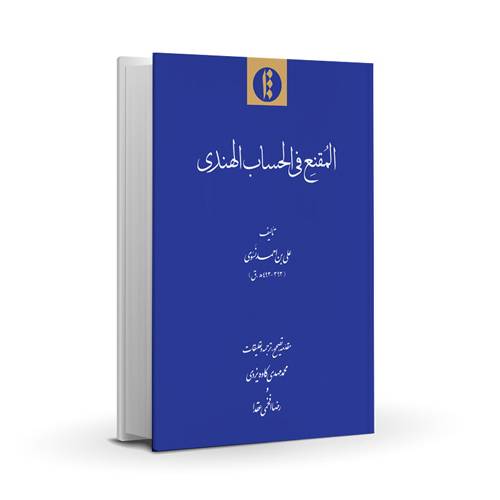
Al-Muqniʿ fī al-Ḥisāb al-Hindī is a mathematical treatise composed by ʿAlī ibn Aḥmad al-Nasawī, a fifth-century scholar born in Rayy. The author originally wrote the work in Persian and subsequently translated it into Arabic. While the Persian original is no longer extant, the Arabic version survives in a single known manuscript preserved in the Leiden University Library.
The book deals with Indian arithmetic and systematically explains fundamental operations such as addition, subtraction, multiplication, division, square roots, and cube roots. These operations are applied across four sections to integers, fractions, mixed numbers, and sexagesimal fractions. Written in a concise and didactic style, the treatise is designed for self-study, with clear explanations accompanied by illustrative examples for each computational method.
This work represents an important witness to the transmission and adaptation of Indian mathematical knowledge in the Islamic world and sheds light on the pedagogical approaches of medieval Persian mathematicians.
Reviews
Reviews
There are no reviews yet.
Be the first to review “al-Moqne’ fi al-Hesab al-Hendi”Cancel Reply



Reviews
There are no reviews yet.